What this RPG is
IKd20 was the first publication that revolved around the world of the iron Kingdoms, Warmachine and Hordes. It was published in 2004 by Privateer Press. That publication is a year after the rules upgrades for d20 in 2003 which we now know as d20 3.5e.
When running d20 3e and 3.5e I liked to incorporate a number of new rules and feats from the d20 3e expansions Defenders of the Faith, Masters of the Wild, Song and Silence, Sword and Fist and Tome and Blood. However for d20 3.5e I had to uprate these expansions to the 3.5e rules set. The results of that are in the DnD 3e section of this site.
We then moved on to Pathfinder (PF1), released in 2009 this was a game changing system for d20 fans as it brought a whole swathe of new features and streamlined rules. We enjoyed several campaigns with that system and it became both a staple and a firm favourite.
Years on now, in 2024 looking back 20 years ago to the original Iron Kingdoms system and it's expansions, I feel something is needed so the players can enjoy their favorite pathfinder features and play the Iron Kingdoms d20 3.5e (or is it more like 3.25e?).
After much deliberation I have ruled out both an adaption to include the 3.5e expansion books and a full conversion, it is simply too much work. The main challenge with a full conversion is the simple fact that a d20 3.5e monster is easy pickings for a PF1 character, and a PF1 monster is a tough challenge for a d20 3.5e character. So too much work to get the balance right, especially when a very simple hack is just as good.
And that is what this is. A simple hack so, I can use my 20 year old Iron Kingdoms rules and expansions with my Pathfinder 1e rules and expansions but without any real effort.
How it works
Races - from Iron Kingdoms Character Guide, Full Metal Fantasy, Volume 1 (IKd20)
Classes - from Pathfinder 1e, fifth/ sixth printing (PF1)
- converting Ranger from PF1 just like IKd20 did from d20
- expanding with bodger, fell caller and gunmage from IKd20, but upgrading them to PF1
- expanding with arcane mechanic from Liber Mechanika (IK-LM), but upgrading it to PF1
Skills - using PF1 as a baseline, then adding the following additional skills from IKd20; Jack Handling, Knowledge:Mechanika and Knowledge:Creature.
- Adding a free unprinted and fixed 6 rank skill for a characters Home area.
- Then clarifying the Crafts that are availible (see the note on the character sheet)
- and finally removing PF1 only skills; Fly, Knowledge:Dungeoneer, Knowledge:Engineering, Knowledge:Local, Knowledge:Planes
- Note that knowledge:steamworks when mentioned, is knowledge:mechanika
- Note that knowledge:firearms (knowing makes and models, etc) when mentioned, is craft:gunsmith or profession:gunsmith, pistolier or similar
Feats - using PF1
Spells - using PF1
Equipment - from IKd20
Character Creation Modifications
When I ran Pathfinder I found that the points system was somehow dull, the rolling dice method was unfair but allowed much more varied characters.
So how to have the best of both worlds? Well you can't in this case, instead I am going to fudge a few dice to help the low stat rollers gain better gear quicker and keep track of who needs the most help. Every now and then I will add a point or two to a secret score I keep for the character.
- For one point I may swap one word in a printed adventure found item, to another similar grade item eg. if a lute of spider climb is found and there is a bard in the group who prefers flute then I will add a point to the secret score and swap the word.
- Or also for one point I will swap a table before dice are rolled in a random treasure check, if the lowest scoring PC is a fighter who needs good armour and a shield to improve him and the treasure rolled randomly includes a wand I will add a point and swap the found thing to be a random roll on the armour and shields chart instead.
- For two points I will go further, if the found item is a lute of spider climb, but the most in need player is a ranger from Lleal and there is no bard in there group then I might swap the item to be a Lleal culture jewelry item instead of a lute.
- Or also for two points I will swap a common loot item for an exotic one. eg. let's say the most in need character has some really rare choice of weapon like a katana, then I will add two points and swap out a printed or randomly rolled longsword so it is a katana.
- Or let's say the most in need PC is a Paladin and has a mount, often a burden that is hard to bring along on every adventure. I could add two points to have the player find an item that alleviates the burden. Perhaps a horses neck strap that can be 'tugged' telepathically so the horse wearing the bridle is found wandering in a plain nearby, or in a stable at the next inn.
----------------
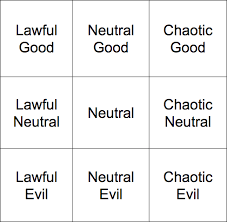
Alignment guide (some believe this is not the standard)
Lawful (LG / LN / LE ) - is about following the rules and having a need for order. Not every personal code of conduct is appropriate. This is about the letter of law of the land and/ or a general method that is orderly (should the laws of the land be vague or chaotic). You will take additional damage and may get targeted by things that are Anarchic (infused with the power of chaos and designed to harm lawful creatures).
Chaotic (CG / CN / CE) - is about being free to make your own choices, having no fixed pattern of behaviour and just taking everything as it comes. When it comes to the law of the land you take a moral view that may at times conflict with the letter of the law as printed. You will take additional damage and may get targeted by things that are Axiomatic (infused with the power of order and designed to harm chaotic creatures).
Neutral (NG, N, NE) - is neither of those, you have a considered and balanced viewpoint that can not be defined as either lawful nor as chaotic. You may seem to take a bit of one, a bit of the other but, your views are consistent and predictable forming a behavioural pattern.
Good (LG / NG / CG) - Whatever your position on order versus chaos is, you strive to do good. You are willing to share evenly with others without looking for an angle that alots you a slightly greater portion. You are also not alignment prejudiced, an evil person in need is still a person in need and you will try to do the right thing for them. I must note that you are not constrained or forced to fall for a con, gullibility is not a component of a good person. Sacrifice is not compulsory either, there are plenty of good people who would not sacrifice themselves for any reason. You will take additional damage and may get targeted by things that are Evil (infused with the power of evil and designed to harm good creatures).
Evil (LE / NE / CE) - Generally this is selfishness in some form rather than a compulsion to harm and destroy everything needlessly. You put yourself above others unless you stand to gain for some reason. An evil character will still help the community they live in but, they will feel that the community owes them or they will insist on compensation in return. You will take additional damage and may get targeted by things that are Good (infused with the power of good and designed to harm evil creatures).
Neutral (NG, N, NE) - is neither of those, you have a considered and balanced viewpoint that can not be defined as either good nor as evil. You may seem to take a bit of one, a bit of the other but, your views are consistent and predictable forming a behavioural pattern.
DnD often draws that in a grid ..